We all adjust ourselves in different situations. But what happens when someone feels they must hide important needs and preferences in order to be accepted?

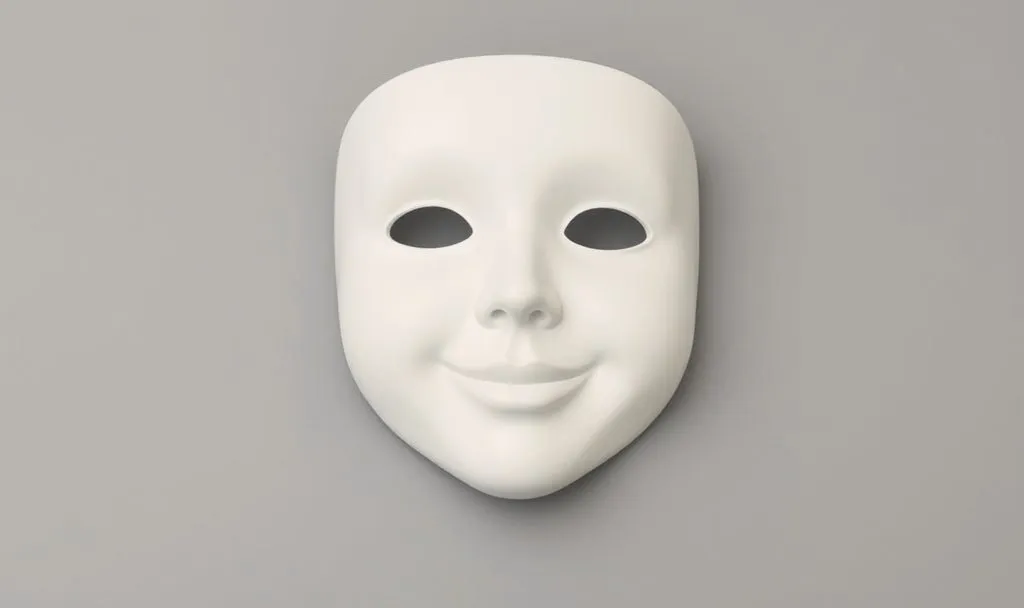
Caleb* wipes the last of the morning tears from his cheeks, his red, swollen eyes the only sign of the morning’s hours of distress. Mask on, he walks to class. The mask shows a boy ready to smile; he’s smart, cooperative, and kind. The mask is him, but there’s so much more that’s unseen: his heart races and stomach churns from the morning’s anxiety about school, his ears buzz from the school bell, he dreads the impending group time in class, he wants to tell everyone about his favourite train, he wants to flap and spin.
But none of that is visible to the people around him.
*Caleb is a composite of many children whose stories have been shared with me.
I often hear from parents that their neurodivergent children operate differently at home compared to when they’re out of the house. This is often called masking or camouflaging. It involves hiding needs, preferences, and difficulties, while imitating those around them or projecting an idealised version of themselves.
In this article, we’ll explore the risks and benefits of masking, hear from neurodivergent people about their experiences, and consider how we can create spaces where people are less pressured to hide their needs, preferences, and difficulties. We’ll also turn to the Bible for hope, encouragement, and guidance.
What can masking look like?
I asked Luke*, an AuDHDer in ministry, about masking. His insights are enlightening:
What are some things you mask?
- I change the way I dress …I don’t want to stand out or for anyone to notice me as different
- I don’t share when something is overwhelming or uncomfortable, especially if everyone else around me seems fine with it
- I try and project an idea that I’m always in control and that nothing can phase me, with a tendency to say yes to people, even if I don’t have the capacity or energy to do it.
- I’m super conscious when it comes to talking about my special interests, fearing that people will get overwhelmed by how deep the rabbit hole can go…
Do you feel you choose to mask, are forced to mask, or is it a combination of both?
Some things I choose to mask as I don’t want people to see me as alien or different, which comes from growing up knowing I was different and being treated that way
When you mask, how does it feel? Does it feel natural, tiring, protective, or something else?
Definitely an element of fake, or at least a partial true me. I’m too scared to give anyone 100% me, if I even know what that looks like.
Do you recognise some of these things in yourself, your child, or someone you love? These questions can be helpful for reflection and conversation. If your child is able to reflect on these questions, discussing them together could be beneficial.
Why mask?
Masking can serve a purpose, as Luke shows. Sometimes it comes from a place of love: he considers the comfort of others, he doesn’t want to ask for changes that others don’t also need, he desires to serve others, and he aims to communicate in ways that suit the people around him.
Masking can also serve to protect a part of the person that they don’t want to share, or to allow them to project something they want to be in that situation.
However, masking can also become a way of hiding genuine difficulties or differences because of fear, as Luke also describes. A person may fear that the way they naturally communicate, interact, or respond to the world will not be accepted,1 and so they feel pressure to conceal what’s really going on.
I asked Sally*, a young autistic girl, if and when she masks, and she told me,
“I hide my feelings and wait until I get home to tell my parents how I feel…When my friend is angry with me, I am too scared to ask why.”
Sally uses masking to go unnoticed, suppressing her feelings in the moment and waiting until she’s somewhere safe to express them.
When masking becomes costly
Sally continues,
“I don’t have any friends I can talk to, so I keep it to myself… I go home and break down. I feel really sad.”
Sally has highlighted two important things about masking: it can involve hiding parts of your experience from others, and it can be very tiring.
Luke (quoted above) also notes:
“It’s a lot of pressure to keep it up. It takes up a lot of energy and I feel like if I slip it will affect relationships and my work.”
Masking can lead to deep mental and physical exhaustion.2 In recent studies, adults report that masking can have a huge impact on mental health and bring a deep sense of loneliness from not being known.3
Also, if someone relies heavily on masking but reaches a point where they no longer have the capacity to maintain it, this can lead to significant social, emotional, and psychological distress.4
Masking can also lead to late or missed diagnosis as the underlying difficulties may go unrecognised.5
It can also mean stress triggers for a person are missed or not believed, and so useful support and accommodations are not provided. Many parents tell me that schools and churches are sceptical about their child’s needs for accommodations because they only see the mask. A mother of two autistic children tells me,
“Our children mask a great deal… Just because someone appears to be coping, doesn’t mean they are.”
All of these can lead to meltdown, shutdown, or exhaustion.
A mother of an autistic daughter says of her daughter,
“[She] masks very well…[but] she pays a big price for playing the social game. When I pick her up from school or a social event she often becomes violent and is very difficult to live with. We have to lock the doors in the car when we drive home because we are worried she will throw herself out of the car in her rage.”
There are mini videos on the platform library on meltdowns, shutdowns, exhaustion and energy.
Is masking always a problem?
The goal is not simply to remove masking. We all adjust ourselves in different situations, and sometimes masking can serve useful functions.
A couple of weeks ago, I was a guest lecturer for parts of a course over three days. By the third day, I had a dreadful headache. I took some pain relief and kept going. I didn’t announce my headache because it wasn’t something I needed help with; I simply wanted to continue teaching about something I’m passionate about.
In a small sense, I was masking my headache. Most of us do this kind of thing sometimes. We don’t share every discomfort or emotion we experience in every situation.
The difference is not whether we adapt our behaviour; we all do that. The difference is whether someone feels they must continually hide important needs, experiences, or differences in order to feel safe and valued.
Reducing the pressure to mask
Research suggests that the pressure to mask is shaped not only by a person’s own understanding of their neurodivergence, but also by how they believe it will be received by others. Negative views of neurodivergence increase the pressure to mask, while positive attitudes reduce the need to hide parts of oneself and are associated with better mental health,6 particularly lower levels of depression and stress.7
This means our communities play an important role.
Society, schools, and churches can reduce the pressure to mask by communicating that difference is valued and by adapting environments so people can participate without hiding important needs or preferences. When people know they will be listened to and supported, they’re more likely to express those needs rather than cope in silence.
Supportive friendships can also reduce the pressure to mask and strengthen a person’s self-esteem. A recent study concluded that:
“young people who had higher autism satisfaction had better psychological well-being and lower social anxiety. Young people who felt more solidarity with other autistic people had higher psychological well-being”8
It’s beneficial to have some friends they can relax around, so they feel free to ask of themselves, “What do I like?” and “How can I contribute and serve with the gifts God has given me?” rather than “What do my friends think I should like?” Or “How do my friends think I should act?”
Families also play a crucial role. When home is a place where needs are understood, differences are welcomed, and support is gladly given, people are less likely to feel they must hide parts of themselves. That confidence may gradually carry into other settings as well.
This kind of understanding and support is often called neuro-affirmation. As Christians, we have particular reasons to be neuro-affirming because we know that every person is hand-made by God (Psalm 139:13–14), equally bears his image (Gen. 1:27), that difference is a gift to the church (1 Cor. 12:12–24), and that God loves us (John 3:16).
At the same time, neuro-affirmation does not mean affirming every desire, thought, or behaviour. All of us are called to grow in Christlikeness, denying ourselves and following Jesus. Neuro-affirmation means recognising that a person’s needs, differences, and strengths are real and should be understood with compassion and care. It encourages participation, confidence, and self-advocacy without pretending that challenges don’t exist. In doing so, it helps reduce the pressure to mask.
The most important thing…
Whether our children are freely expressing themselves or carefully adjusting their interactions to navigate a situation, they should model everything on Jesus, just as all Christians should. We don’t model ourselves simply on the expectations around us, but on Jesus, walking like him and seeking to bring glory to God, as 1 Peter 2 encourages us to do. Verse 9 says,
“But you are a chosen people, a royal priesthood, a holy nation, God’s special possession, that you may declare the praises of him who called you out of darkness into his wonderful light.”
Christians are saved in Christ (v. 24) and have the privilege of following his example (v. 21), living a changed and righteous life (v. 24) so that people “may see your good deeds and glorify God” (v. 12).
As I’ve said before: Let’s not model ourselves on the average person, but on the best person: Jesus.
*Names have been changed
Notes
-
A fairly recent study sought to understand the nature, motivations, and consequences of masking and developed the first self-report measure of camouflaging behaviours. Table 4 and Figure 1 are particularly interesting. Hull, L., Mandy, W., Lai, M.-C., Baron-Cohen, S., Allison, C., Smith, P., & Petrides, K. V. (2019). Development and validation of the Camouflaging Autistic Traits Questionnaire (CAT-Q). Journal of Autism and Developmental Disorders, 49(3), 819–833.
-
Hendrickx, S., Sarah Hendrickx Presentation at Axia’s 25th Anniversary Celebration, Axia ASD, 2023 Aug 10.
-
There are many studies to point to, but some helpful ones are: Hull, L., Lai, M.-C., Baron-Cohen, S., Allison, C., Smith, P., Petrides, K., & Mandy, W. (2020). Gender differences in self-reported camouflaging in autistic and non-autistic adults. Autism: The International Journal of Research and Practice, 24(2), 352–363. https://doi.org/10.1177/1362361319864804 AND Hull, L., Petrides, K. V., Allison, C., Smith, P., Baron-Cohen, S., Lai, M.-C., & Mandy, W. (2017). “Putting on my best normal”: Social camouflaging in adults with autism spectrum conditions. Journal of Autism and Developmental Disorders, 47(8), 2519–2534. AND Bradley, L., Shaw, R., Baron-Cohen, S., & Cassidy, S. (2021). Autistic Adults’ Experiences of Camouflaging and Its Perceived Impact on Mental Health. Autism in Adulthood, 3(4), 320–329. https://doi.org/10.1089/aut.2020.0071
-
Attwood, T. and Garnett, M. (2023). Exploring Friendship in High School, Webcast event: Attwood and Garnett Events. attwoodandgarnettevents.com
-
Pearson, A., & Rose, K. (2021). A conceptual analysis of autistic masking: Understanding the narrative of stigma and the illusion of choice. Autism in Adulthood, 3(1), 52–60.
-
Perry, E., Mandy, W., Hull, L., & Cage, E. (2022). Understanding camouflaging as a response to autism-related stigma: A social identity theory approach. Journal of Autism and Developmental Disorders, 52(2), 800–810. https://doi.org/10.1007/S10803-021-04987-W AND Pearson, A., & Rose, K. (2021). A conceptual analysis of autistic masking: Understanding the narrative of stigma and the illusion of choice. Autism in Adulthood, 3(1), 52–60.
-
Cage, E., Di Monaco, J., & Newell, V. (2018). Experiences of autism acceptance and mental health in autistic adults. Journal of Autism and Developmental Disorders, 48, 473–484.
-
Cooper, K., Russell, A. J., Lei, J., & Smith, L. G. (2023). The impact of a positive autism identity and autistic community solidarity on social anxiety and mental health in autistic young people. Autism, 27(3), 848–857.